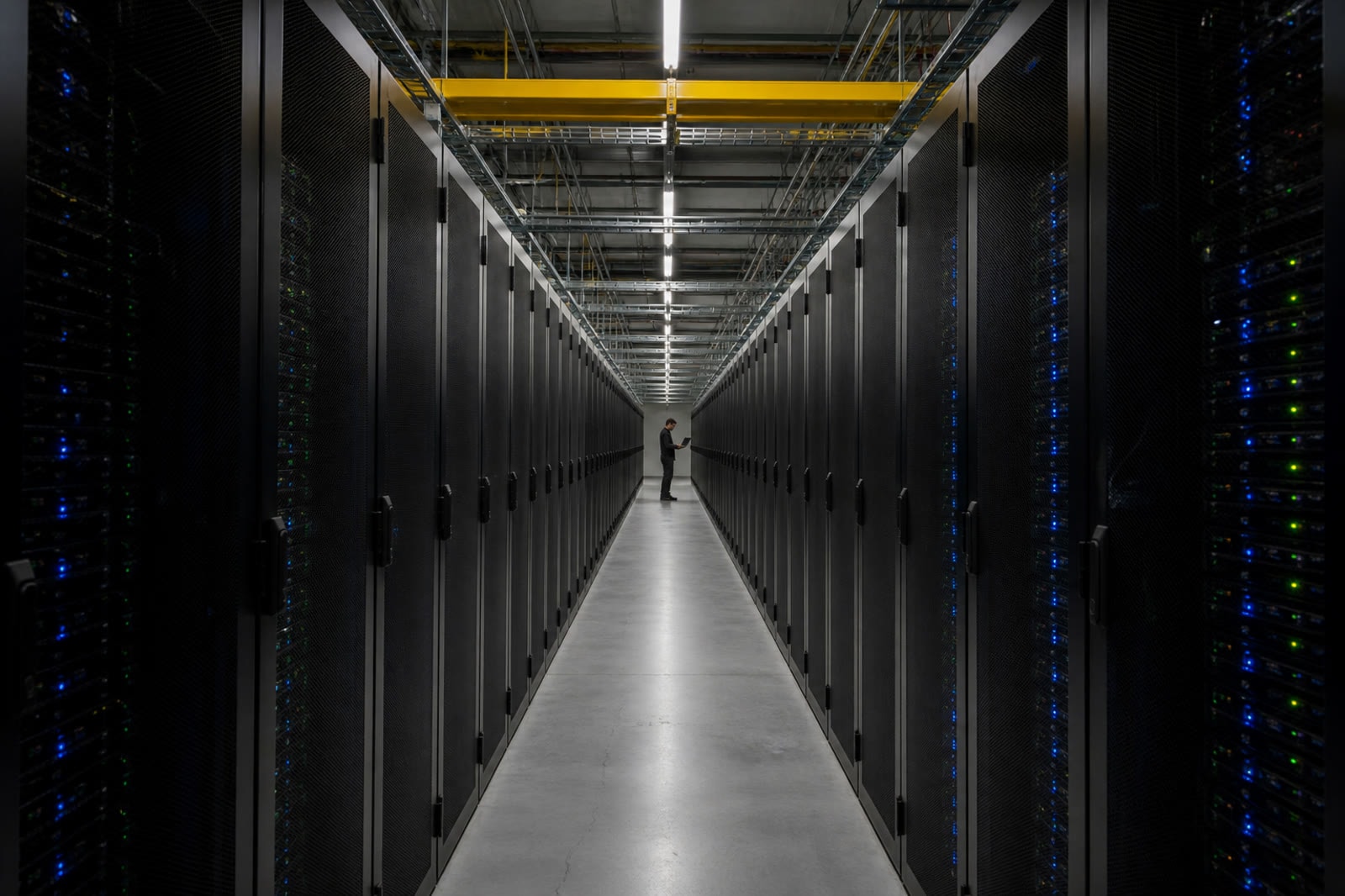
The first thing you notice is the sound — a low, ceaseless white roar, like standing inside a jet engine that never takes off. The second is the cold: a wall of chilled air pushed through kilometers of ducting to keep half a million processors from cooking themselves.
This campus, whose operator granted access on condition its location not be disclosed, is one of the largest computing facilities ever built. When its final hall comes online next year, it will draw more than 900 megawatts — roughly the output of a mid-sized nuclear reactor, dedicated almost entirely to training and running artificial intelligence models.
It is not alone. Industry trackers count more than 140 comparable projects under construction worldwide, a build-out that has turned computing into one of the fastest-growing sources of electricity demand on the planet.
Grid operators are struggling to keep pace. In three major markets, utilities have paused new data center connection requests entirely, citing years-long backlogs for transformers and transmission lines. In others, developers have taken matters into their own hands, signing direct deals for dedicated gas plants, small modular reactors and gigawatt-scale solar farms.
Every query, every generated image, every model update ends here — in a building the size of an aircraft hangar, drawing as much power as a small city.
The energy industry, for its part, has noticed that its newest customers have very deep pockets. “These are the most creditworthy offtakers we have ever seen,” said an executive at one power developer. “They will sign twenty-year contracts tomorrow. The constraint is not money. It is time.”
Critics argue the boom is distorting energy transitions, diverting clean power that would otherwise displace fossil fuels. Operators counter that their demand is financing renewable capacity that would never otherwise be built, and point to waste heat recovery schemes now warming homes in several northern cities.
Inside the hall, the debate feels abstract. Racks stretch to a vanishing point under service lights, each one worth more than the average house, each one replaced on a cycle measured in months, not years.
What is being manufactured here is not a product in any traditional sense. It is capability — the raw computational substrate of an economy that increasingly runs on prediction. The electricity map of the next decade is being drawn, quietly, in buildings like this one.