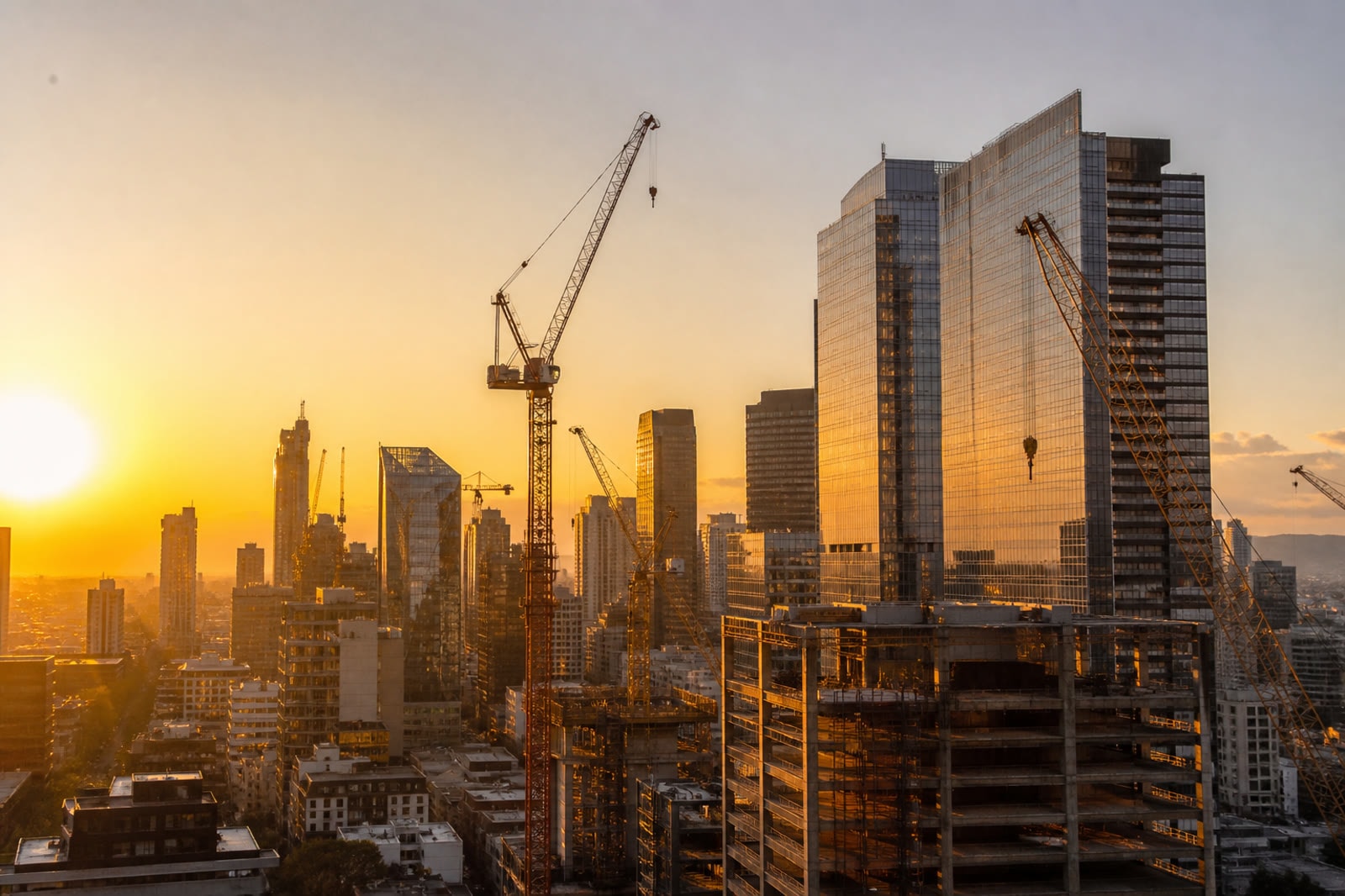
The cranes are back. Across a dozen major cities, developers restarted work on more than 60 high-rise projects in the past quarter, according to new industry data — the clearest sign yet that the deep freeze in urban construction is thawing as borrowing costs retreat.
The revival marks a sharp turn from two bleak years in which rising rates, expensive materials and empty offices combined to stall projects at every stage, leaving skylines dotted with half-finished frames and fenced-off pits.
Falling finance costs are the immediate trigger. Development loans that priced at double-digit rates eighteen months ago are now being struck several points lower, transforming the arithmetic on projects that had been shelved as unbuildable.
But the recovery is selective. Residential towers account for nearly three-quarters of the restarts, reflecting acute housing shortages in most major markets. Speculative office construction, by contrast, remains close to a standstill.
“The market has repriced what cities are for,” said one development chief whose firm converted two stalled office schemes to apartments this year. “People came back. Their desks, only partly.”
Economists caution that construction is a long-cycle business, and today’s groundbreakings will not ease housing pressure for years. Materials costs remain elevated, and skilled labor is scarce nearly everywhere.
Still, city officials are seizing the moment. Three municipal governments announced fast-track approval schemes this summer aimed at converting the restart wave into a sustained pipeline. The cranes, they are betting, can be kept busy for a decade.