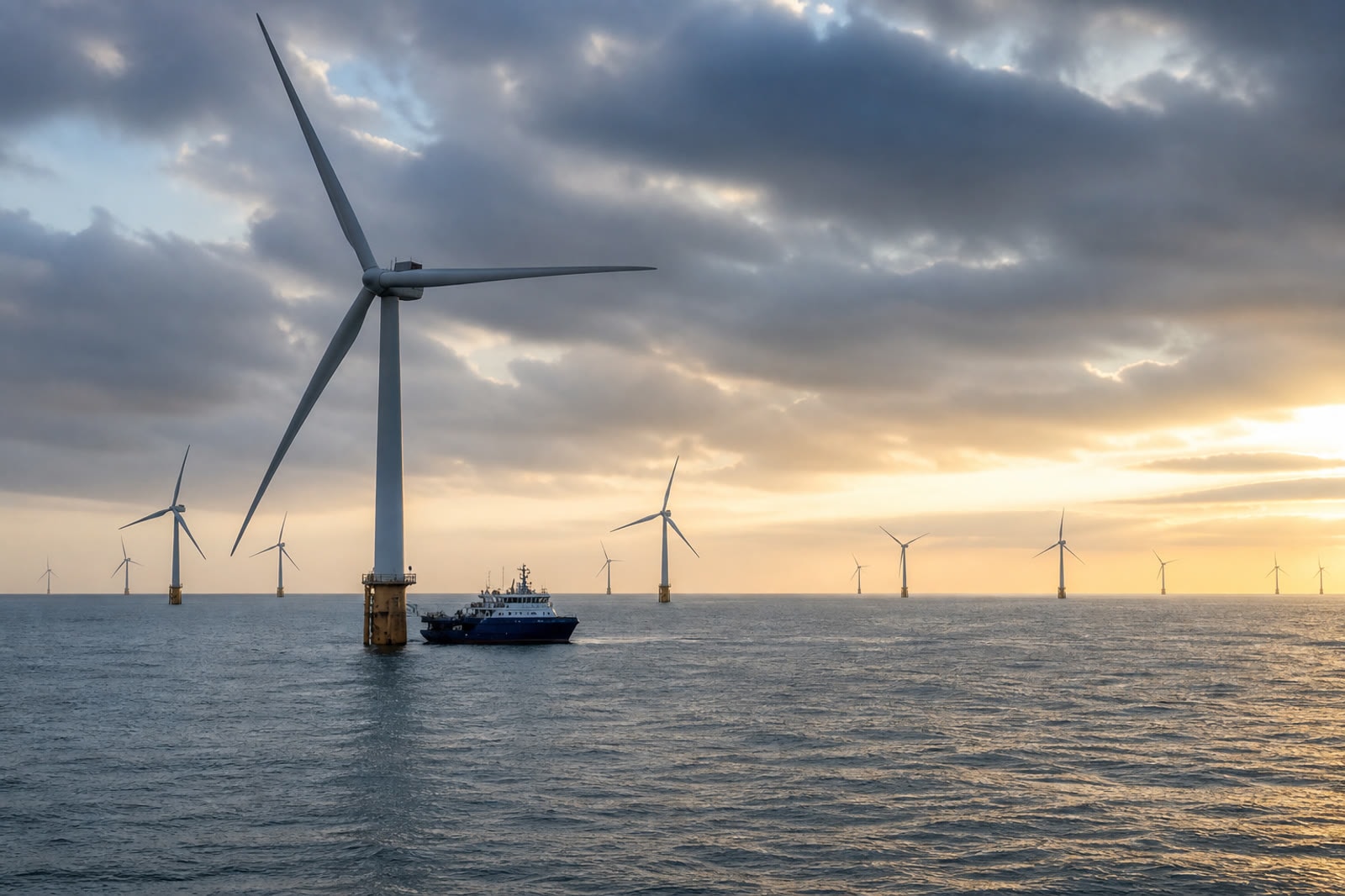
ESBJERG, Denmark — Offshore wind farms generated a record 96 terawatt-hours of electricity last quarter, new industry data shows, cementing the technology’s place as the fastest-scaling source of clean power in the northern hemisphere.
The milestone reflects a decade of plunging costs and swelling turbine sizes. The latest machines being installed off the Danish coast stand taller than the Eiffel Tower and can each power a town of 40,000 homes.
But the industry’s success is colliding with a problem it did not build and cannot solve alone: the grid. Across Europe and North America, connection queues have lengthened dramatically, with some completed wind farms waiting months to deliver their first full-capacity output.
“We can build a wind farm in three years. The cable to connect it can take seven,” said Mette Sørensen, chief operating officer of a major developer, in an interview at the port here, where next-generation foundations are stacked like giant chess pieces awaiting deployment.
We can build a wind farm in three years. The cable to connect it can take seven.
The bottlenecks are physical as much as bureaucratic. High-voltage subsea cable is produced by only a handful of factories worldwide, and their order books are full into the 2030s. Specialist installation vessels are similarly scarce.
Governments have begun to respond. Three North Sea states announced a joint procurement framework for transmission infrastructure this summer, and regulators in two markets have moved to fast-track permits for onshore substations — often the slowest link in the chain.
Analysts say the next two years will determine whether the record quarter was a peak or a plateau. The pipeline is enormous: projects totalling four times today’s installed capacity have secured seabed rights. Whether the electrons they generate can actually reach consumers is now the defining question of the offshore era.